Expected reading time: 10 minutes
Microsoft’s AI Heaven
Microsoft’s AI portfolio, Copilot, Agent 365 and the M365 E7 stack, represents a clear productivity leap. License it now, get ahead of the curve, and the ROI will follow as adoption matures. Your renewal is the right moment to make that move.
What We Actually See on the Ground
Microsoft’s fiscal year closed at the end of June. Ours didn’t. At Leadout, renewal season ends with a debrief. After another intense cycle of negotiations, adoption assessments, and frank conversations about what clients bought versus what they actually use, the picture is consistent: organisations are committing to AI capabilities they are not ready to absorb.
Copilot adoption is struggling across the board. Many clients report that the majority of users who have access to Copilot do not use it frequently or effectively enough to realize its full value. As a result, many organizations struggle to achieve the expected return on their investment without focused user adoption, training, and ongoing enablement. This is not because the technology is without merit, but rather because it demands data governance maturity, workflow integration, and change management discipline that most organisations haven’t built yet. Moreover, Copilot Studio (the tool that would allow organisations to customise and extend Copilot into their own workflows) sees minimal utilisation across our client base. Most customers aren’t close to the maturity level that would make it valuable, yet they are already paying for the stack that includes it.
The E7 story follows a similar arc. Microsoft is actively positioning E7 as the default future-state workplace package, the inevitable next step for any organisation that wants to remain current. The upgrade path is deliberate: from E3 to E5, from E5 to Copilot-enabled bundles, each step framed as a natural progression. In particular, discounts are structured to reinforce this direction, often tied to enterprise-wide deployment assumptions rather than any proven business demand on the customer’s side. In other words, the commercial logic is clear. However, the organisational readiness to match it, in most cases, is not.
The Growing Gap Between AI Ambition and Organisational Readiness
What we consistently see is a gap between where Microsoft wants customers to be and where they actually are. In reality, most organisations are simply not mature enough to absorb large volumes of E7 or Copilot licensing, yet the commercial pressure pushes them in that direction regardless. Purchasing happens. Deployment lags. As a result, the discount that made the deal look attractive at signing quietly locks in a cost base the organisation is years away from fully using. For example, organizations that purchase Microsoft Copilot licenses for approximately one-third of their user base can experience a 20-30% increase in the annual cost of their Enterprise Agreement. While the investment can deliver meaningful productivity gains, it also represents a significant increase in licensing spend.
In addition, Agent 365 is arriving with a meaningful gap between its commercial documentation and its technical reality: features prominent in sales materials that aren’t always available, prerequisites that quietly reshape the business case, and deployment timelines longer than presented. And the billing structure is moving in one direction: Copilot Cowork and emerging consumption-based configurations are stacking new costs on top of baselines many organisations already find hard to justify.
The pitch is polished. The deployment experience is not. Consequently, most buyers are signing before they’ve closed that gap.
Why Organizations Keep Falling Into the Same Trap
Two forces are driving it, and they reinforce each other.
The first is vendor sophistication. Microsoft’s commercial strategy has grown sharper. For instance, it sequences conversations deliberately, applies renewal pressure at the right moments, and channels boardroom anxiety about AI into purchasing decisions before internal readiness has been properly assessed. As a result, vendor power is growing faster than the governance capabilities most organisations have developed to match it.
The second is internal pressure. “We need to do something with AI” is a real mandate in most large organisations right now. Microsoft is exceptionally good at meeting that mandate with a product and a timeline. Therefore, the result is urgency without rigour: decisions made at the pace of the sales cycle rather than the pace of the organisation’s actual capacity to implement.
However, here’s the twist: this isn’t a new dynamic. It’s the same pattern that played out with cloud migrations, with M365 rollouts, and with every major platform shift before it. As we explored in our previous article, The Dangerous Illusion of SaaS Compliance, organisations often mistake software ownership for software control. In other words, the organisations that got burned then are getting burned again, just with a different product name on the invoice.
The Hidden Costs of a Microsoft Renewal
The license fee is visible. The real cost isn’t.
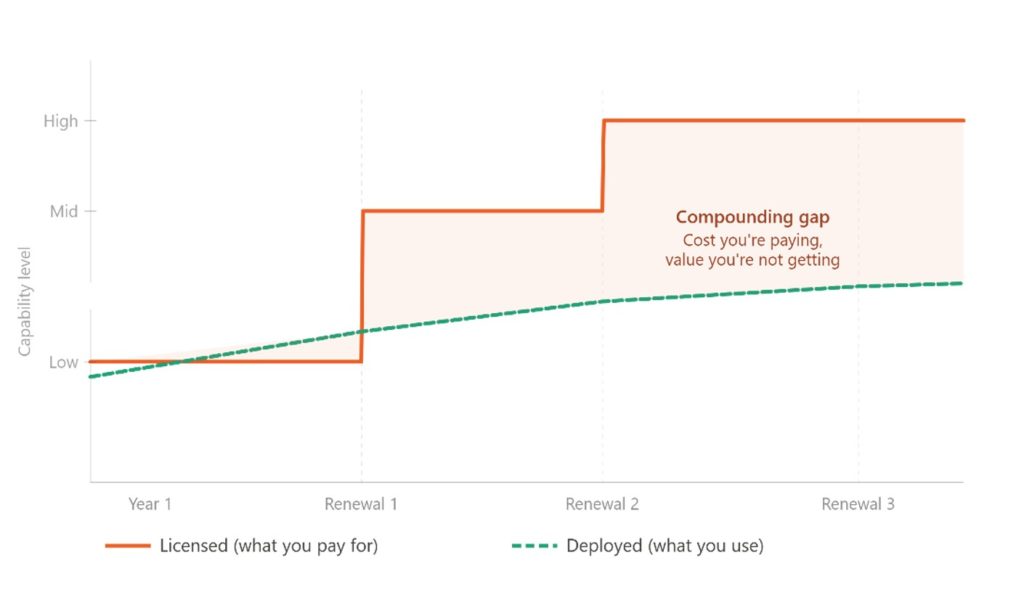
When an organisation purchases capabilities, it isn’t ready to deploy, the gap between “licensed” and “used” opens quietly and compounds over time.
Change management that wasn’t budgeted for. Integration work that takes quarters, not weeks. Meanwhile, adoption milestones that slip, then disappear. Eventually, the next renewal arrives and the cycle repeats, with a slightly higher baseline and slightly less negotiating credibility.
Full deployment of major Microsoft stack changes takes years. In fact, not quarters, but years. Purchasing new features means purchasing the possibility of outcomes, contingent on internal readiness that no vendor will deliver for you. For example, according to Gartner, more than 50% of generative AI proof-of-concept projects fail to progress into production due to challenges such as weak data quality, inadequate governance, increasing costs, and limited business value (Gartner, 2025).
The Next Cost Challenge: Consumption-Based AI Licensing
Furthermore, the shift toward tokenisation (consumption-based AI licensing replacing predictable per-seat economics) will make cost forecasting significantly harder for organisations that haven’t built the governance frameworks to track and control usage. In addition, as third-party AI tools multiply across the enterprise stack, the prospect of Microsoft requiring licensing or integration layers to operationalize those tools within its ecosystem is a directional risk that deserves attention now, not after the next contract is signed.
Did SAP Offer a First Glimpse of Microsoft’s Next Move?
For instance, we’ve already seen the playbook executed elsewhere. SAP’s updated API policy effectively blocks third-party AI tools from accessing SAP data, steering customers toward its own AI capabilities instead. The message was clear: if you want AI to work inside our ecosystem, you’ll use our product. Therefore, Microsoft has every commercial incentive to follow the same logic.
From Optional Governance Tool to Potential Licensing Requirement
In other words, Agent 365, in that scenario, stops being an optional add-on and becomes a prerequisite: the license you need before your existing AI investments can function inside the Microsoft environment. If that happens, the shift will not arrive as a negotiation. Instead, it will arrive as a policy update. As a result, the organisations that haven’t mapped this exposure will feel it in their next renewal.
The absence of lifecycle thinking is where the real cost lives. Rather, not in the invoice, but in the compounding gap between what you paid for and what you deployed.
What Mature Organizations Do Differently
The organisations that consistently achieve strong outcomes in Microsoft renewals don’t move faster. Instead, they move with more structure.
Firstly, they test before they commit. New capabilities run through structured pilots with defined success criteria. A compelling demo is never sufficient justification. Moreover, ROI is calculated against a real baseline before any commercial conversation begins. As a result, the purchasing decision is the last step, not the first.
They look at the full Microsoft relationship, not just the EA. Azure, Dynamics, Surface, MSDN, CSP. Microsoft is embedded across most large organisations in ways that extend well beyond a single enterprise agreement. Consequently, the strongest negotiators bring all of that leverage to the table simultaneously, rather than treating each contract as if it exists in isolation.
Secondly, they have a signed roadmap before they have a signed contract. Technology commitments are anchored to the IT roadmap, the business strategy, commitment from the relevant IT stakeholders, and realistic implementation capacity. When the roadmap hasn’t been approved internally, the answer to the vendor is simple: not yet.
Finally, they treat IT governance as a commercial capability, not as a compliance function. Knowing your actual consumption, your genuine requirements, and your realistic to-be state is what creates negotiating room. Transparency about the as-is is not a reporting exercise. It is leverage.
Seven Moves to Strengthen Your Next Microsoft Renewal
1. Conduct a consumption audit before any renewal conversation starts.
Know what you’re using, what you’re not, and what the gap is costing you in real terms. In our experience, many organizations have unused licenses sitting on the shelf, quietly adding unnecessary cost. As a result, this single step changes the entire dynamic of a Microsoft negotiation.
2. Challenge the E3 to E5 to E7 upgrade narrative.
Discounts tied to enterprise-wide deployment assumptions are only attractive if you can actually deploy enterprise-wide. Before accepting any bundle upgrade, establish adoption milestones and measurable outcomes. Then, make those a condition of the commercial commitment, not an afterthought.
3. Run a structured pilot on Agent 365 and Copilot before committing at scale.
Map the gap between commercial documentation and technical reality for your specific environment. For example, verify feature availability, deployment prerequisites, and realistic timelines against your own infrastructure, not the vendor’s reference case.
4. Build your roadmap approval process into your renewal calendar.
No product commitment should reach the signing stage without an internally approved implementation roadmap that includes adoption milestones, change management resource, and a realistic go-live timeline.
5. Map your full Microsoft commercial footprint.
Identify every active agreement, every renewal date, and every usage data point across the relationship. In other words, negotiate the whole, not the parts.
6. Model tokenisation scenarios now.
Additionally, understand how a shift to consumption-based AI licensing would affect your cost structure, and build that into your financial planning before Microsoft makes the decision for you.
7. Qualify ROI before licensing, not after.
Define what success looks like in measurable terms (productivity baselines, process outcomes, adoption thresholds) and make that definition a condition of the purchasing decision.
The Leadout Perspective
Undoubtedly, the quality of a Microsoft renewal is determined long before the renewal date arrives. That’s not a consulting observation, it’s what the data from every engagement we run confirms.
Organisations that come to us mid-negotiation are working uphill.
Why Timing Changes the Outcome
Time pressure has already narrowed their options. By contrast, the ones we work with continuously start from a different position entirely. They understand their actual consumption. They know their leverage. They’ve mapped their to-be state, and they’re not purchasing for a future they haven’t committed to building.
Turning Governance into Negotiating Leverage
Our approach is a thorough demand assessment of the as-is (what is licensed, what is used, what is needed) combined with a structured qualification of the to-be roadmap. As a result, that combination is what makes every subsequent commercial conversation one you can have from a position of clarity rather than urgency.
Microsoft is a sophisticated vendor with a sophisticated commercial strategy. Therefore, the organisations that navigate it well treat IT governance as a strategic discipline. It directly shapes what they pay, what they deploy, and what they hold back. If that discipline isn’t in place yet, building it is the first move. After that, everything else follows from there.
Key Takeaways
Copilot’s adoption problem is a governance problem, not a product problem.
Licensing ahead of data maturity and change management readiness produces spend without return. In short, readiness before licensing. Not the other way around.
The E3 to E7 upgrade path is a commercial strategy, not a roadmap.
Discounts tied to enterprise-wide deployment assumptions only create value if the organisation is ready to deploy at that scale. Most aren’t. Therefore, establish adoption milestones before accepting bundle upgrades and treat Copilot Studio utilisation as the honest benchmark of where you actually are.
Agent 365 requires independent verification before commitment.
The gap between marketing documentation and technical reality is real. Accordingly, pilot, validate, and map prerequisites against your own environment before signing at scale.
Vendor power is growing, match it with governance capability.
Microsoft’s commercial sophistication is increasing. As a result, organisations that negotiate in isolation, under time pressure, or without a full view of their commercial relationship will consistently leave value on the table.
Tokenisation is the next cost management challenge.
The shift toward consumption-based AI licensing will reshape how Microsoft costs are forecast and controlled. Therefore, build the internal frameworks to manage this before the model changes on you.
Lifecycle discipline separates strong buyers from reactive ones.
Purchasing without a signed roadmap and realistic adoption milestones is how the gap between licensed and used opens, and compounds. In essence, closing that gap before the renewal, not after, is the job.
Transparency is leverage.
A clear, honest picture of as-is consumption and to-be requirements is the single most powerful input into any software negotiation. In other words, it is not a reporting function. It is a commercial advantage.
Leadout specialises in software asset management and renewal advisory. We work with large multinational companies in strongly regulated environments to ensure their software investments are grounded in real usage, aligned to business strategy, and structured to hold value over time.
Curious how this applies to your organization? Let’s talk, schedule a call with us.

Share this message: